
Bold Blue and Gold Living Room Design: Creating a Dramatic Luxury Interior
A living room can feel luxurious without being limited to pale neutrals or minimal decoration. In some interiors, the strongest character comes from contrast: a saturated upholstery colour, warm metallic details, layered wall treatments and lighting that gives the room a theatrical glow.
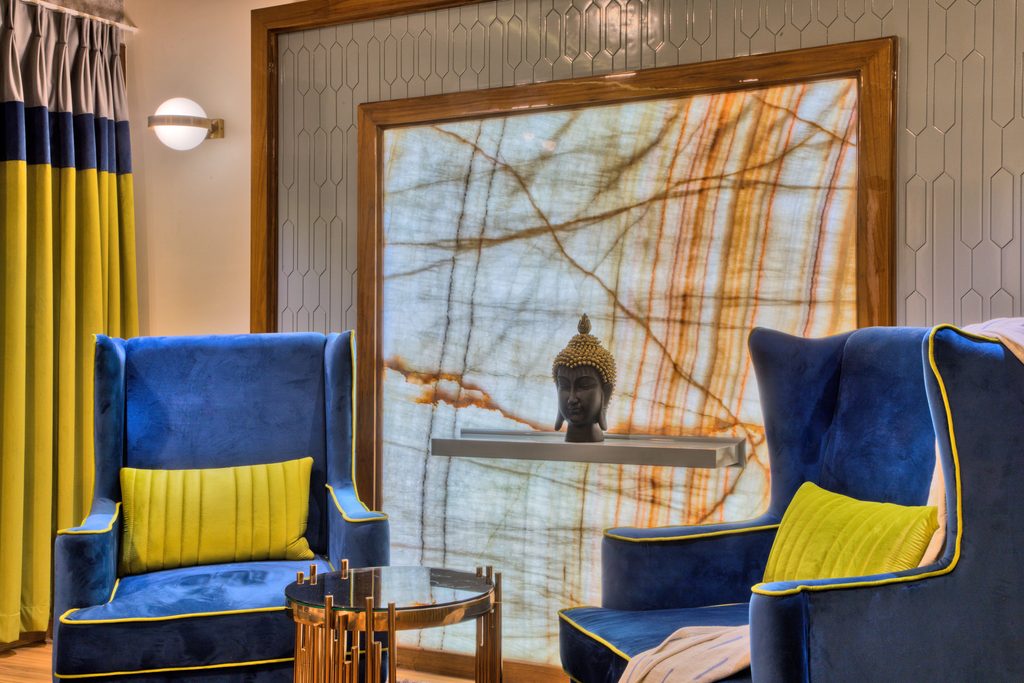
The supplied image presents a bold lounge composition centred on a deep blue sofa with rounded arms and contrasting yellow piping. Behind it, a richly detailed feature wall combines vertical divisions, geometric linework, warm brown framing and a cream-and-orange veined surface. A globe pendant light adds a softer circular form, while the glass-topped table and decorative accents introduce reflective details.
The result is an interior that feels dramatic, expressive and carefully composed. It demonstrates how a living room can use colour, proportion, pattern and lighting to create a memorable luxury experience.
1. Start with one defining statement piece
The deep blue sofa is the visual anchor of the room. Its scale fills the foreground, immediately establishing the seating area as the main focus. The rounded padded arms make the sofa feel comfortable and substantial, while the yellow piping outlines its silhouette and makes the form even more noticeable.
A statement sofa can shape the entire direction of a living room. Once its colour, scale and profile are established, the surrounding walls, cushions, table, curtains and accessories can be selected to support it rather than compete with it.
For a bold furniture piece to feel intentional, the room needs balance. The sofa should be proportionate to the wall behind it, leave comfortable circulation around the seating area and provide enough depth for relaxed use. Its colour should also appear elsewhere in smaller touches so that it feels connected to the rest of the interior.
2. Use blue as a sophisticated foundation
Blue can create very different moods depending on its depth and saturation. The navy or royal-blue upholstery visible here gives the room a rich, confident character. It is strong enough to command attention but also versatile enough to work with warm wood-look framing, cream surfaces, gold accents and soft neutral curtains.
Deep blue works particularly well in luxury living room design because it can suggest depth and calm at the same time. It also provides a strong background for contrasting colours. In this interior, the yellow piping and cushions stand out clearly against the sofa, creating a high-impact colour relationship.
When using a saturated colour across a large piece of furniture, surrounding surfaces should be coordinated carefully. A quieter floor, balanced wall tone or controlled curtain palette can prevent the composition from becoming visually overwhelming.
3. Introduce a controlled complementary accent
The yellow and yellow-green details provide an important counterpoint to the blue. The colour appears in the piping, cushions and a vertical curtain accent. Because it is repeated in several places, it reads as a deliberate design element rather than an isolated decoration.
A strong accent colour should be used with discipline. It can appear in upholstery trim, cushions, a side chair, curtains, lighting details or selected accessories. Repetition creates rhythm, but excessive repetition can reduce the sense of luxury.
The most effective approach is usually to let one colour dominate and allow the accent to support it. Here, blue remains the primary visual field, while the yellow details add energy and improve the definition of the furniture and textiles.
4. Make the feature wall part of the architecture
The wall behind the sofa is not treated as a plain background. It appears to combine multiple layers: broad vertical and horizontal divisions, warm brown framing, raised geometric linework and a prominent veined panel. These elements create depth and give the seating area a strong architectural identity.
A feature wall should be designed in relation to the furniture placed in front of it. The sofa hides part of the lower wall, so the most important visual details are positioned where they remain visible above and around the seating. This creates a backdrop that frames the sofa without making the furniture disappear.
Geometric wall detailing can also establish rhythm. Repeated linked shapes or elongated motifs guide the eye across the surface and make a large wall feel more structured. The geometry should be proportioned carefully so that it complements the room rather than becoming a distracting pattern.
5. Layer different surface qualities
The visual richness of this living room comes partly from the contrast between surfaces. The sofa and cushions appear soft and fabric-like. The veined wall panel appears glossy or stone-like. The table has a clear glass-like top and reflective metallic-looking supports. The surrounding wall sections appear more subdued and matte.
Combining different surface qualities helps a luxury interior feel layered. Soft upholstery makes the room comfortable, while reflective surfaces catch the light and add a sense of refinement. A quieter background prevents every surface from competing for attention.
The exact materials should be confirmed before publication. From the photograph alone, the veined panel cannot be identified with certainty as natural stone, engineered stone, laminate or another finish. The design lesson is the visible contrast between veining, upholstery, glass-like transparency and warm framing.
6. Balance geometry with rounded forms
The wall uses strong linear divisions and repeated geometric motifs, while the sofa introduces curves through its arms and cushions. The globe pendant adds another rounded form near the centre of the composition.
This balance is important. A room made entirely of straight lines can feel rigid, while a room dominated only by curves may lack structure. Combining geometry with rounded furniture produces a more complete visual language.
The same principle can be applied in other interiors. A linear feature wall may be paired with a curved sofa. A rectangular coffee table may be softened with rounded accessories. Straight cabinetry may be balanced by circular lighting or organic upholstery.
7. Use lighting to soften a dramatic palette
The spherical white pendant light creates a gentle focal point above the seating composition. Its round form contrasts with the vertical wall treatment, while its light colour prevents the upper part of the room from becoming too dark against the saturated sofa and warm wall detailing.
Lighting also appears to reflect across the glossy or stone-like wall surface and metallic-looking table elements. This adds movement to the composition as the surfaces respond differently to the light.
A successful living room lighting plan should include more than a single decorative pendant. Ambient lighting, concealed lighting, task lighting and accent lighting can be combined to support different moods. A brighter setting may be useful for everyday activity, while softer illumination can make the blue and gold palette feel more intimate in the evening.
The technical lighting plan should account for glare, shadow, colour temperature, maintenance and the position of reflective surfaces.
8. Select cushions as part of the colour composition
The cushions do more than add comfort. They repeat the room’s primary and accent colours, helping the sofa connect with the feature wall and curtains. Yellow-green cushions with blue edging echo the main contrast, while darker cushions maintain continuity with the sofa upholstery.
Cushions are an efficient way to test and refine a colour scheme. They can introduce a secondary tone without requiring permanent changes to walls or furniture. Their size, edge treatment and arrangement also influence how formal or relaxed the seating feels.
For a balanced result, cushions should vary slightly in tone, scale or pattern while sharing at least one common colour. This creates a collected appearance rather than a perfectly matched but flat arrangement.
9. Treat curtains as part of the room design
The left side of the image shows heavy pleated curtains beside what appears to be a window opening. Dark blue, neutral and mauve-grey sections are visible, along with a bright yellow vertical accent near the edge.
Curtains can influence both the mood and proportion of a living room. Full-height drapery can make a wall feel taller and provide softness beside a harder feature surface. It can also support privacy and light control, although those performance characteristics should be confirmed from the actual specification.
In this composition, the curtains help carry the blue-and-yellow colour story away from the sofa. This is a useful strategy when a strong furniture colour needs to be repeated without adding another large object.
10. Keep reflective details controlled
The partly visible glass-topped table introduces transparency in front of the sofa. Its warm metallic-looking supports appear to relate to the gold and brown tones of the wall and decorative object at the right.
Transparent and reflective furniture can prevent a bold interior from feeling too heavy. A glass-like surface preserves visual openness, while a metallic frame catches the light and adds a refined accent.
Reflective elements should be positioned with care. They can create glare, reveal clutter or compete with glossy wall panels if overused. One or two controlled reflective details are often enough to add sophistication without making the room feel busy.
11. Build luxury through composition, not excess
Luxury is not created by adding as many decorative elements as possible. It comes from selecting a clear hierarchy and giving each major element enough space to be appreciated. In this image, the hierarchy is easy to read: the blue sofa leads, the feature wall frames it, the yellow accents energise it, and the globe pendant softens the upper composition.
The decorative object at the right appears ornamental, but it remains secondary to the larger furniture and architectural elements. This restraint helps the room feel expressive while maintaining visual order.
A premium interior benefits from accurate proportions, carefully resolved junctions, coordinated colours and consistent detailing. These qualities are developed during the design process and protected during execution.
12. Plan comfort alongside visual impact
A dramatic living room should still be comfortable for everyday use. The sofa needs appropriate seat depth and support, the table should be reachable without blocking movement, and the circulation route around the seating should remain clear.
Feature walls, curtains, lighting and furniture also need to work together functionally. The final design should consider cleaning, maintenance, access to electrical points, light control and the long-term suitability of upholstery and wall finishes.
The photograph shows the visual composition, but practical details such as dimensions, ergonomics, accessibility and material performance should be reviewed in the drawings and specifications before execution.
13. A considered design process for expressive interiors
An expressive living room begins with understanding the client’s preferences, lifestyle, space and desired atmosphere. At Prisca Design, the process moves through Ideation, Conceptualization and Execution.
During Ideation, the design direction can be shaped around the desired mood: calm, dramatic, warm, theatrical or understated. Conceptualization then develops the colour palette, furniture forms, wall treatment, lighting and material relationships. Execution translates the approved idea into a coordinated interior with attention to detail.
This process is particularly important when using bold colours and layered architectural features. Strong design decisions need careful coordination so that the final result remains comfortable, purposeful and visually balanced.
Luxury living room design checklist
Before finalising a bold living room interior, consider the following:
- What is the main statement element: sofa, wall, lighting or artwork?
- Is one colour clearly dominant, with accents used selectively?
- Are the feature-wall proportions related to the furniture in front of it?
- Do curved and linear forms balance one another?
- Does the lighting support both everyday use and evening atmosphere?
- Are glossy and reflective finishes controlled to avoid glare?
- Do cushions and curtains repeat the colour story naturally?
- Is there enough circulation around the seating and table?
- Have upholstery, wall finishes and lighting been selected for practical maintenance?
- Are the project name, location, exact materials and project status confirmed before publishing the image?
Frequently asked questions
How can blue be used in a luxury living room?
Deep blue can be introduced through a sofa, accent wall, curtains, cushions or selected cabinetry. It works well with warm neutrals, brass- or gold-toned details, cream surfaces and controlled lighting. The surrounding palette should be balanced so the room feels rich rather than overwhelming.
What colours work well with a blue sofa?
Warm yellow, mustard, cream, taupe, brown, gold and selected green tones can complement a blue sofa. The exact combination depends on the depth of the blue, the available daylight and the other finishes in the room.
How can a feature wall become the focal point of a living room?
Use proportion, contrast, texture, lighting and alignment with the main furniture. A feature wall becomes more effective when its geometry frames the sofa or seating area and when its details are visible from the primary approach to the room.
Are bold interiors difficult to maintain?
Not necessarily. Maintenance depends on the selected upholstery, wall finish, flooring, lighting and frequency of use. Materials should be evaluated for cleaning, wear, repair and replacement before they are approved.
How do I make a dramatic interior feel comfortable?
Balance saturated colours and strong patterns with comfortable furniture, softer textiles, warm lighting and clear circulation. Curved furniture and layered fabrics can make a bold room feel more approachable.
Final thought
A memorable living room is often created through a confident relationship between colour, furniture and architecture. This image shows how a deep blue sofa can become the starting point for a complete interior language. Yellow piping and cushions add energy, the geometric feature wall creates depth, warm framing connects the composition, and the globe pendant introduces softness.
The broader design lesson is that bold interiors become successful when every major decision supports the same atmosphere. With careful planning, balanced proportions and a considered execution process, colour-rich living rooms can feel luxurious, comfortable and highly personal.
If you are planning a luxury residential interior in Ahmedabad, speak with Prisca Design about developing a living room that reflects your lifestyle, preferences and design identity.
Call: +91-9825147727
Email: prisca88design@gmail.com
Website: https://priscadesign.com
